
5.1 vs 7.1 vs 9.2 Dolby Atmos Speaker Setup Explained — The Complete Buyer's Guide for Indian Homes
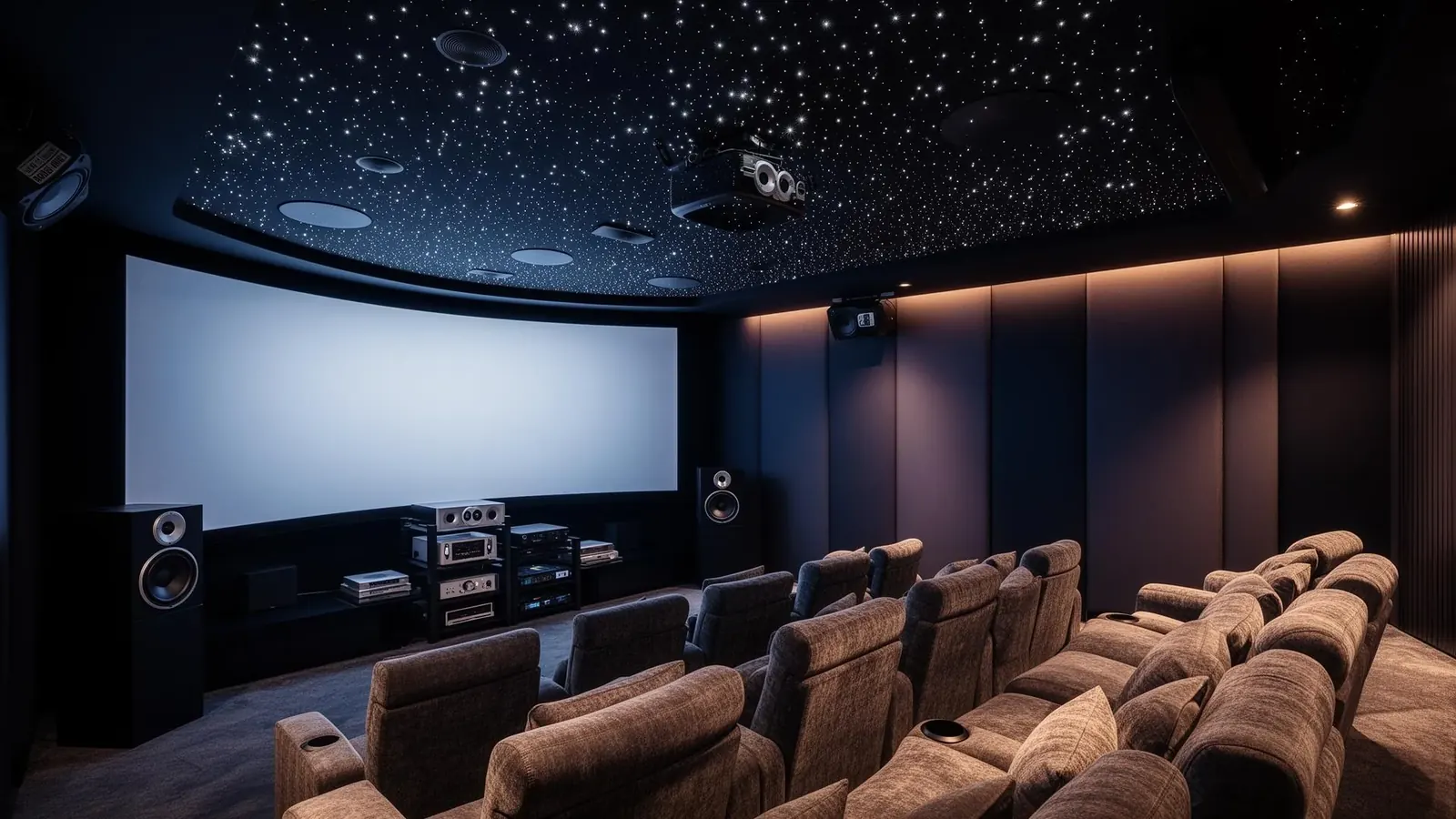
Featured answer — 5.1 vs 7.1 vs 9.2 Dolby Atmos in one paragraph
A 5.1 setup uses five speakers plus one subwoofer and is the right fit for most Indian living rooms and 2BHK apartments. A 7.1 setup adds two rear-surround speakers for wider, more enveloping surround coverage and suits larger 3BHK homes and independent house living rooms. A 9.2 Dolby Atmos setup adds two front-height (or ceiling) speakers and a second subwoofer for true three-dimensional overhead sound — the reference configuration for dedicated home theatre rooms and private cinema builds. Choose 5.1 for comfort, 7.1 for scale, and 9.2 Atmos for cinematic immersion.
Key takeaways (TL;DR)
- ▸
5.1 = 5 speakers + 1 subwoofer
ideal for 150–300 sq ft living rooms and most 2BHK apartments.
- ▸
7.1 = 7 speakers + 1 subwoofer
ideal for 300–450 sq ft rooms, 3BHK homes and larger open-plan spaces.
- ▸
9.2 Atmos = 7 ground-level speakers + 2 height/ceiling speakers + 2 subwoofers
reference-grade immersion for dedicated theatre rooms.
- ▸
Dolby Atmos requires at least two height or ceiling speakers
a 5.1.2 or 7.1.4 layout is often more valuable than raw channel count.
- ▸
Room size, seating position and acoustic treatment matter more than any brand logo on the box.
- ▸
Atmos setups need an AVR that decodes Dolby Atmos and DTS:X
always confirm channel processing capability, not just channel count.
- ▸
LiveInSmart has completed 1,000+ AV installations across Hyderabad, Vijayawada, Visakhapatnam, Warangal, Nizamabad, Guntur and Tirupati.
Why the right speaker configuration matters
Home theatre buyers in India spend months comparing brands — Denon vs Marantz, JBL vs Klipsch, Sony vs Yamaha — and almost no time comparing configurations. That's backwards. The single biggest factor in how a home theatre actually sounds is the number, type and placement of speakers relative to the room and seating. A ₹1.5-lakh 5.1 system in a well-treated room outperforms a ₹5-lakh 9.2 Atmos rig crammed into the wrong space, every time.
At LiveInSmart, our AV consultants have designed and installed over 1,000 systems across Andhra Pradesh and Telangana — from compact 2BHK apartments in Hyderabad's Gachibowli to full private cinemas in Vijayawada, Visakhapatnam and Tirupati. This guide distils that experience into a clear, non-salesy breakdown of the three most common speaker configurations, so you can decide which one is right for your room, your budget and how you actually watch.
What do the numbers actually mean? 5.1, 7.1, 9.2, 5.1.2, 7.1.4 explained
Every home-theatre configuration is written as three numbers: X.Y.Z. The first number is the count of ground-level speakers (front, centre and surrounds). The second is the number of subwoofers. The third — when present — is the number of height or ceiling speakers used for Dolby Atmos.
- ▸
5.1
Five ground speakers (front L, centre, front R, surround L, surround R) plus one subwoofer. No height channels.
- ▸
7.1
Adds two rear-surround speakers behind the seating position. Still no height channels.
- ▸
5.1.2
5.1 base with two overhead/height speakers. The entry point to Dolby Atmos.
- ▸
7.1.4
7.1 base with four overhead/height speakers. The Dolby-recommended layout for serious Atmos.
- ▸
9.2
Nine ground speakers (7.1 plus two front-height or front-wide) with dual subwoofers. Sometimes written as 9.2.0 or extended to 9.2.4 for full Atmos.
5.1 Dolby Atmos setup — the practical standard
A 5.1 setup is the most common home-theatre configuration in India for good reason. It delivers proper surround separation, is well within the wall/wire realities of most apartments, and works with virtually every AVR on the market. When paired with an Atmos-capable soundbar or two upfiring Atmos modules, a 5.1.2 arrangement can deliver a convincing overhead effect without the ceiling work.
- ▸
Best for
2BHK apartments, standard 3BHK living rooms and rooms of 150–300 sq ft.
- ▸
Speaker layout
Front L/C/R across the TV wall, surrounds slightly behind the main seat at ear level, subwoofer in a corner or front wall.
- ▸
Typical AVR power
90–120 W per channel, mid-tier Denon, Marantz, Yamaha or Onkyo models.
- ▸
Best fit brands
Klipsch Reference, JBL Studio 6, Polk Signature Elite, KEF Q Series.
- ▸
Cost in ₹
Entry ₹80,000–₹1,50,000 · Mid ₹1,50,000–₹3,50,000 · Premium ₹3,50,000+ (GST-inclusive, includes install).
- ▸
Ideal viewing distance
8–12 ft from front speakers.
7.1 Dolby Atmos setup — for larger rooms and open-plan homes
The jump from 5.1 to 7.1 adds two rear-surround speakers directly behind the seating position. This closes the 'gap' behind the listener that 5.1 setups can have in larger rooms and makes panning effects — helicopters, cars, footsteps — feel more continuous. Add four overhead speakers and you have 7.1.4, the layout Dolby officially recommends for reference Atmos playback.
- ▸
Best for
3BHK homes, independent house living rooms, open plan living-dining spaces of 300–450 sq ft.
- ▸
Speaker layout
Front L/C/R, side surrounds at ear level level-with or slightly behind the seat, rear surrounds on the back wall, subwoofer on the front wall.
- ▸
Typical AVR power
110–150 W per channel, upper-mid Denon AVR-X3800H, Marantz Cinema 50, Yamaha RX-A6A class.
- ▸
Best fit brands
Klipsch Reference Premiere, JBL Studio 6/HDI, Focal Chora, KEF R Series.
- ▸
Cost in ₹
Mid ₹3,00,000–₹6,00,000 · Premium ₹6,00,000–₹12,00,000+ (installed).
- ▸
Ideal viewing distance
10–14 ft from front speakers.
9.2 Dolby Atmos setup — the reference cinema experience
A 9.2 configuration is where home theatre stops being an upgrade and starts being an experience. Nine ground-level speakers create front-wall width and wraparound surround coverage that a 7.1 setup can't match, and dual subwoofers even out low-frequency response so the person sitting on the right of the sofa hears the same bass punch as the person on the left. Extended to 9.2.4 or 9.2.6, this is the layout used in dedicated home cinemas and private theatre projects.
- ▸
Best for
Dedicated home theatre rooms, private cinemas, luxury villa media rooms 450+ sq ft.
- ▸
Speaker layout
Front L/C/R, two front-wide (or front-height), side surrounds, rear surrounds, four ceiling speakers (Top-Front + Top-Rear), two subwoofers on opposite walls.
- ▸
AVR / processor
11.2 or 13.2 channel AVR (Denon AVR-A1H, Marantz Cinema 30) or dedicated processor + power amps (Storm Audio, Trinnov, Anthem).
- ▸
Best fit brands
Klipsch Reference Premiere / THX, JBL Synthesis, Focal Aria/Sopra, PMC Ci Series.
- ▸
Cost in ₹
Reference ₹12,00,000–₹40,00,000+ including acoustic treatment, projector and calibration.
- ▸
Ideal viewing distance
12–18 ft from screen; typically 2–3 rows of seating.
Comparison table — 5.1 vs 7.1 vs 9.2 Dolby Atmos at a glance
- ▸
Total speakers
5.1: 6 · 7.1: 8 · 9.2: 11 (13–15 with Atmos heights).
- ▸
Height channels
5.1: 0 (2 optional as 5.1.2) · 7.1: 0 (4 optional as 7.1.4) · 9.2: 4 standard, up to 6.
- ▸
Recommended room size
5.1: 150–300 sq ft · 7.1: 300–450 sq ft · 9.2: 450+ sq ft dedicated.
- ▸
Recommended seating rows
5.1: 1 row · 7.1: 1–2 rows · 9.2: 2–3 rows.
- ▸
AVR channels needed
5.1: 5.1 or 7.2 · 7.1: 7.2 or 9.2 · 9.2: 11.2 or 13.2 (or processor + amps).
- ▸
Cabling complexity
5.1: Low · 7.1: Medium · 9.2: High (ceiling routing, dual sub cables).
- ▸
Cost range (₹)
5.1: 80K–3.5L · 7.1: 3L–12L · 9.2: 12L–40L+.
- ▸
Ideal for
5.1: Living rooms · 7.1: Large living/media rooms · 9.2: Dedicated theatres, private cinemas.
- ▸
Immersion level
5.1: Very good · 7.1: Excellent · 9.2: Reference / cinematic.
Speaker placement — where the real magic happens
Dolby publishes exact angles for every speaker, and following them is the difference between 'Atmos-labelled' and 'actually Atmos'. Front L/R sit at ±22–30° from the seating position. Surrounds at ±90–110°. Rear surrounds at ±135–150°. Top-Front ceiling speakers at ±30° elevation, Top-Rear at ±150°. Height speakers must be either in-ceiling or on-wall mounted at least 40° above the listener's ear line — upfiring modules can approximate this but need a flat, reflective ceiling 8–12 ft high.
In Indian homes, ceiling routing is often the deciding factor. False ceilings are common in premium apartments and villas across Hyderabad, Vijayawada and Visakhapatnam — which makes in-ceiling Atmos speakers straightforward. In rented flats or buildings with slab ceilings, upfiring Atmos modules on top of the front L/R speakers are a practical alternative.
Common mistakes we see in the field
- ▸
Buying 9.2 for a 2BHK
Overkill on channels, undersized room, poor result. A tuned 5.1.2 would sound better.
- ▸
Ignoring the subwoofer position
A 'boomy' room is almost always a placement problem, not a subwoofer problem.
- ▸
Skipping acoustic treatment
Bare walls and glass windows destroy Atmos precision. Even light treatment (rugs, curtains, one absorption panel per wall) transforms the result.
- ▸
Buying the AVR last
Channel processing is the ceiling of your system; buy the processor first, then match speakers.
- ▸
Assuming soundbars = Atmos
Most soundbars 'simulate' Atmos with DSP. A proper 5.1.2 with real speakers is dramatically better.
- ▸
Ceiling speakers wired to the wrong output
Very common DIY mistake; height channels get sent to surround outputs and lose the overhead effect entirely.
- ▸
No calibration
Every system needs Audyssey / Dirac / YPAO calibration or a manual REW sweep. Skipping this leaves 30–40% of performance on the table.
Which setup fits which Indian home? Real-world use cases
- ▸
Hyderabad 2BHK apartment (Gachibowli / Kondapur)
5.1 or 5.1.2 with soundbar-style upfiring modules. Around ₹1.5–3 lakh installed.
- ▸
Vijayawada 3BHK villa living room
7.1.2 with in-ceiling Atmos. ₹4–8 lakh installed.
- ▸
Visakhapatnam sea-view penthouse media room
7.1.4 with acoustic treatment for glass walls. ₹8–15 lakh installed.
- ▸
Warangal / Nizamabad independent house
5.1.4 or 7.1.4 depending on room size, typically ₹3–10 lakh installed.
- ▸
Guntur / Tirupati luxury villa dedicated theatre
9.2.4 with laser projector, 3-row recliner seating and acoustic room-in-room build. ₹15–40 lakh+.
- ▸
Farmhouse or private cinema project
9.2.6 processor-based build with Trinnov or Storm Audio. ₹40 lakh+.
Cost considerations — what actually drives the price
The AVR and speakers are often less than half the total budget of a serious install. Cabling (properly rated in-wall speaker cable, HDMI 2.1 for 4K/120Hz and 8K sources), calibration, acoustic treatment, seating, mounts and civil work (false ceiling modification, painting, wall recesses) all add up. As a rough breakdown for a mid-tier 7.1.4 project in Andhra Pradesh or Telangana: 45% speakers + AVR, 15% cabling and accessories, 15% acoustic treatment, 10% seating, 10% installation and calibration, 5% civil work.
Expert recommendations — the LiveInSmart shortlist
- ▸
Best 5.1 under ₹2L
Denon AVR-X1800H + Klipsch Reference R-600F 5.1 pack.
- ▸
Best 5.1.2 under ₹4L
Marantz Cinema 70s + Klipsch Reference Premiere + RP-500SA Atmos modules.
- ▸
Best 7.1.4 under ₹10L
Denon AVR-X3800H + JBL Studio 6 series + in-ceiling JBL 8124.
- ▸
Best 9.2.4 under ₹25L
Marantz Cinema 30 + Klipsch Reference Premiere RP-8060FA II + dual SVS PB-2000 Pro.
- ▸
Reference 9.2.6
Storm Audio ISP Elite MK3 + JBL Synthesis + dual JL Audio Fathom subwoofers.
Industry best practices we follow
- ▸
Design before purchase
Every LiveInSmart project starts with a room drawing, seating plan and speaker angle chart before a single component is quoted.
- ▸
Certified calibration
Audyssey MultEQ XT32, Dirac Live and manual REW measurements are part of every install, not an optional add-on.
- ▸
Acoustic pre-treatment
At least first-reflection and rear-wall treatment on every dedicated room; full RT60-targeted treatment on cinema builds.
- ▸
Brand-authorised
Denon, Marantz, Klipsch, JBL, Focal, KEF, Sony, Epson, BenQ — always with genuine warranty and India-wide service.
- ▸
End-to-end responsibility
Design, supply, install, calibrate, support — one team, one accountable partner.
Future trends — where Dolby Atmos is heading
- ▸
Dolby Atmos FlexConnect
Wireless Atmos speaker calibration built into Atmos-enabled TVs (LG, Hisense) is making retrofits far easier.
- ▸
8K / 4K 120Hz sources
HDMI 2.1 AVRs are now standard; older 4K-only AVRs will feel dated by 2027.
- ▸
Object-based audio in streaming
Netflix, Disney+ Hotstar and Prime Video have expanded Atmos catalogues, making the format more mainstream in India.
- ▸
AI room calibration
Dirac Live ART and next-gen Audyssey are closing the gap between DIY and professionally-tuned rooms.
- ▸
Immersive audio in commercial spaces
Private theatres, boardrooms and premium restaurants are increasingly specifying Atmos-capable systems.
Why choose LiveInSmart as your Dolby Atmos partner
LiveInSmart Technologies is one of the leading AV Consultants and Smart Technology Integrators in Andhra Pradesh and Telangana, with 1,000+ completed installations across Hyderabad, Vijayawada, Visakhapatnam, Warangal, Nizamabad, Guntur and Tirupati. We're a technology consulting and solutions partner, not a product seller — every recommendation is anchored in your room, your seating, your budget and how you actually watch, not a brand quota.
- ▸
✓ 1,000+ AV installations across Andhra Pradesh & Telangana.
- ▸
✓ End-to-end design, supply, install and calibration.
- ▸
✓ Professional AV consultants
Dolby, THX and CEDIA-aligned methodology.
- ▸
✓ Premium brand partnerships with genuine warranties.
- ▸
✓ Strong after-sales support
calibration, troubleshooting and upgrade planning in-house.
- ▸
✓ Commercial private theatre and building automation expertise.
Conclusion — pick the setup, not just the speakers
The choice between 5.1, 7.1 and 9.2 Dolby Atmos isn't a specification contest — it's a fit exercise. Match the configuration to your room, budget and use case, and even the entry-tier gear delivers a result you'll enjoy for years. Force the wrong configuration into the wrong room and no amount of premium equipment will fix it.
If you'd like a room-specific recommendation — with a scaled drawing, speaker placement plan and quote in ₹ — book a free consultation with a LiveInSmart AV consultant. Serving Hyderabad, Vijayawada, Visakhapatnam, Warangal, Nizamabad, Guntur, Tirupati and beyond.
Frequently asked questions
What is the difference between 5.1, 7.1 and 9.2 Dolby Atmos setups?+
5.1 uses 5 speakers plus 1 subwoofer, 7.1 adds two rear surrounds for eight-speaker coverage, and 9.2 adds two more front speakers plus a second subwoofer. When extended with height channels (e.g. 5.1.2, 7.1.4, 9.2.4), they become Dolby Atmos configurations with true overhead sound.
Which is better — 5.1 or 7.1 for a home theater?+
7.1 offers more enveloping surround coverage and works better in larger 3BHK homes and open-plan rooms above 300 sq ft. For 2BHK apartments and standard living rooms, a well-placed 5.1 (or 5.1.2 Atmos) actually performs better than a cramped 7.1.
Do I need 9.2 Dolby Atmos for my home theater?+
Only if you have a dedicated theatre room of 450 sq ft or larger with 2–3 rows of seating. For everyday living rooms and media rooms, a 5.1.2 or 7.1.4 configuration delivers most of the immersion at a fraction of the cost and complexity.
What is the minimum setup for Dolby Atmos?+
The minimum Dolby Atmos configuration is 5.1.2 — five ground-level speakers, one subwoofer and two overhead or upfiring height speakers. Anything less is not true Atmos, even if the system is marketed with the Atmos logo.
Can I install a 7.1.4 Dolby Atmos system in a Hyderabad apartment?+
Yes, provided the room is at least 300 sq ft and the ceiling can accommodate in-ceiling or on-wall height speakers. LiveInSmart has completed dozens of 7.1.4 installs in Hyderabad, Vijayawada and Visakhapatnam apartments — the false-ceiling designs common in premium Indian apartments make this straightforward.
What is the cost of a 5.1 Dolby Atmos setup in India?+
A quality 5.1 or 5.1.2 setup in India ranges from ₹80,000 for entry-tier packages to ₹3.5 lakh for premium brand-authorised systems, installed and calibrated. Exact cost depends on speaker brand, AVR class and acoustic treatment scope.
What is the cost of a 9.2 Dolby Atmos home theater in India?+
A full 9.2.4 or 9.2.6 dedicated home cinema in India typically costs between ₹15 lakh and ₹40 lakh, including acoustic treatment, projector, seating and professional calibration. Reference-tier builds with Trinnov or Storm Audio processing exceed ₹40 lakh.
How many speakers do I need for Dolby Atmos?+
The Dolby-recommended minimum is 5.1.2 (eight speakers total). The reference configuration is 7.1.4 (twelve speakers) and larger dedicated theatres use 9.2.4 or 9.2.6 (fifteen to seventeen speakers).
Where should ceiling speakers be placed for Dolby Atmos?+
Dolby recommends Top-Front speakers at ±30° elevation from the primary listening position and Top-Rear speakers at ±150°. In a typical living room, that means one pair roughly above the front L/R speakers and another pair slightly behind the seating position.
Do upfiring Atmos speakers work as well as ceiling speakers?+
In-ceiling and on-wall height speakers deliver noticeably better Atmos localisation than upfiring modules. Upfiring modules are a good compromise when ceiling routing isn't possible, but they need a flat, hard ceiling between 8 and 12 ft high to reflect correctly.
Which AVR is best for a 7.1.4 Dolby Atmos setup?+
Popular choices in India include the Denon AVR-X3800H, Marantz Cinema 50, Yamaha RX-A6A and Onkyo TX-RZ70. All decode Dolby Atmos, DTS:X and IMAX Enhanced, and support 4K/120Hz and 8K HDMI 2.1 sources.
Is Dolby Atmos worth it for a normal living room?+
Yes — even a 5.1.2 setup in a standard living room adds a clear sense of height and space to Atmos content on Netflix, Disney+ Hotstar and Prime Video. The upgrade over conventional 5.1 is immediately audible on any Atmos-mixed movie or music track.
Does LiveInSmart install Dolby Atmos systems outside Hyderabad?+
Yes. LiveInSmart serves Hyderabad, Vijayawada, Visakhapatnam, Warangal, Nizamabad, Guntur, Tirupati and other cities across Andhra Pradesh and Telangana, with end-to-end design, installation and calibration by our in-house team.
What acoustic treatment is needed for Dolby Atmos?+
At minimum, first-reflection absorption on the side walls, rear-wall absorption or diffusion and a subwoofer-friendly floor covering. For dedicated rooms, LiveInSmart designs treatment to a target RT60 of 0.3–0.5 seconds, matching Dolby's home-theatre recommendations.
How long does it take to install a Dolby Atmos system?+
A 5.1 or 5.1.2 installation typically takes 1–2 days including calibration. A 7.1.4 install takes 3–5 days depending on ceiling and cable routing. A dedicated 9.2.4 or 9.2.6 home cinema build with acoustic treatment and seating usually runs 4–8 weeks end to end.
Related on LiveInSmart
22 min read
Acoustic Treatment — The Complete 2026 Guide for Homes, Studios, Offices, Auditoriums & Commercial Spaces in India
8 min read
Home Theatre Installation Cost in Hyderabad & Vijayawada — 2026 Buyer's Guide
10 min read
How to Design a Dedicated Dolby Atmos Home Theatre in Hyderabad: The 2026 Checklist