Dolby Atmos Home Theatre: Complete Setup & Speaker Placement Guide
Plan the height layer as part of the room—not as an accessory. This guide connects configuration, ceiling method, listening positions, receiver capability, acoustics, wiring and calibration.
Placement establishes the geometry; measurement and listening complete the integration.
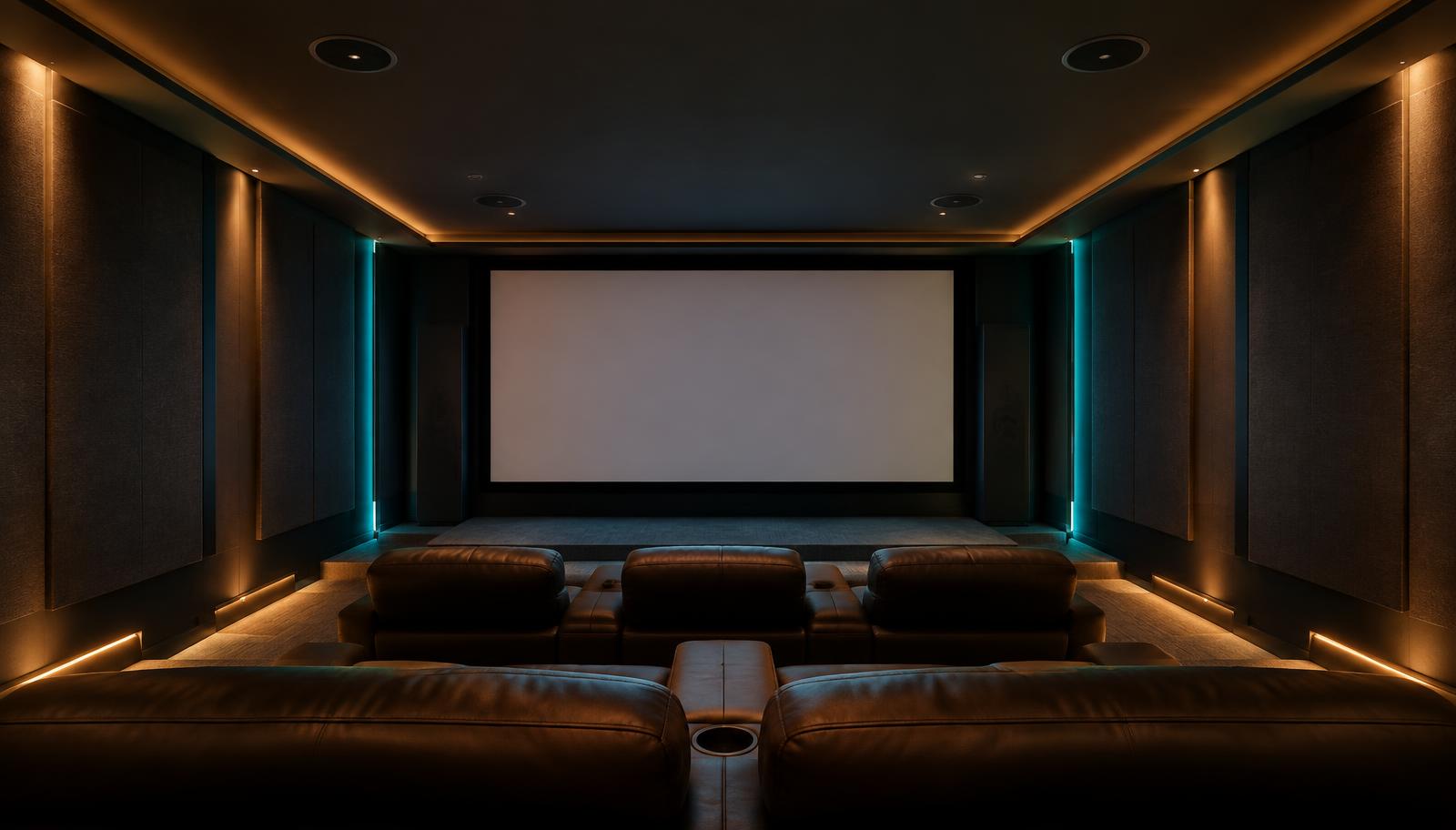
A distinct overhead layer needs clear separation from ear-level speakersThe layout begins at the seatsProcessing, amplification and wiring must support the intended layout
What is Dolby Atmos?
Dolby Atmos is an immersive audio format that can place compatible sound objects above and around the listener. In a home theatre, the complete chain matters: compatible source and content → playback device → AV receiver or processor → amplification → ear-level, bass and height speakers → room. The final digit in 5.1.2 or 7.1.4 identifies independently reproduced height channels.
Read 5.1.2, 5.1.4, 7.1.2 and 7.1.4 Correctly
Dolby uses X.Y.Z layout notation. X describes the main ear-level channels, Y describes the low-frequency-effects channel, and Z describes height channels. The notation does not necessarily equal the physical number of subwoofers: more than one sub can reproduce the same managed bass channel.
Atmos configuration comparison
Layout
Ear-level
LFE
Height
Planning fit
5.1.2
5
1
2
Compact living room or media room
5.1.4
5
1
4
Single-row room seeking stronger front-to-back overhead movement
7.1.2
7
1
2
Longer room with useful rear-surround space
7.1.4
7
1
4
Larger dedicated room with space around the seats
Choose the Room Before the Channel Count
A layout is useful only when the room can create meaningful separation. A sofa against the rear wall usually cannot support convincing rear surrounds, while a low or interrupted ceiling may restrict reflected height modules. Treat the examples below as starting points, then confirm the geometry against the room and current Dolby setup guidance.
Small living room
Start with 5.1 or 5.1.2 when side surrounds and two suitable height positions can relate clearly to the sofa.
Medium media room
5.1.2 or 5.1.4 may work, depending on ceiling construction, seating spread and available amplification.
Dedicated theatre
5.1.4 or 7.1.4 can be considered when there is real space behind the listening area and four height positions can form front-to-back separation.
In-Ceiling, On-Ceiling and Up-Firing Height Speakers
Dolby describes multiple ways to reproduce height information. Direct-radiating in-ceiling or on-ceiling speakers can create precise localization when positioned and aimed for the seats. Up-firing Atmos-enabled speakers use ceiling reflection and therefore depend more heavily on ceiling height, shape, material and obstructions. A soundbar is another implementation, but it should not be described as physically identical to a correctly installed discrete layout.
Factor
Direct ceiling speaker
Up-firing module
Installation
Requires planned mounting and cable access
Lower construction impact
Ceiling dependency
Structure and safe mounting matter
Flat, suitably reflective ceiling is important
Localization
Depends on placement and aiming
Depends strongly on room and reflection path
Appearance
Can be visually discreet
Visible on or integrated with ear-level speakers
Atmos Speaker Placement Is Listener-Referenced
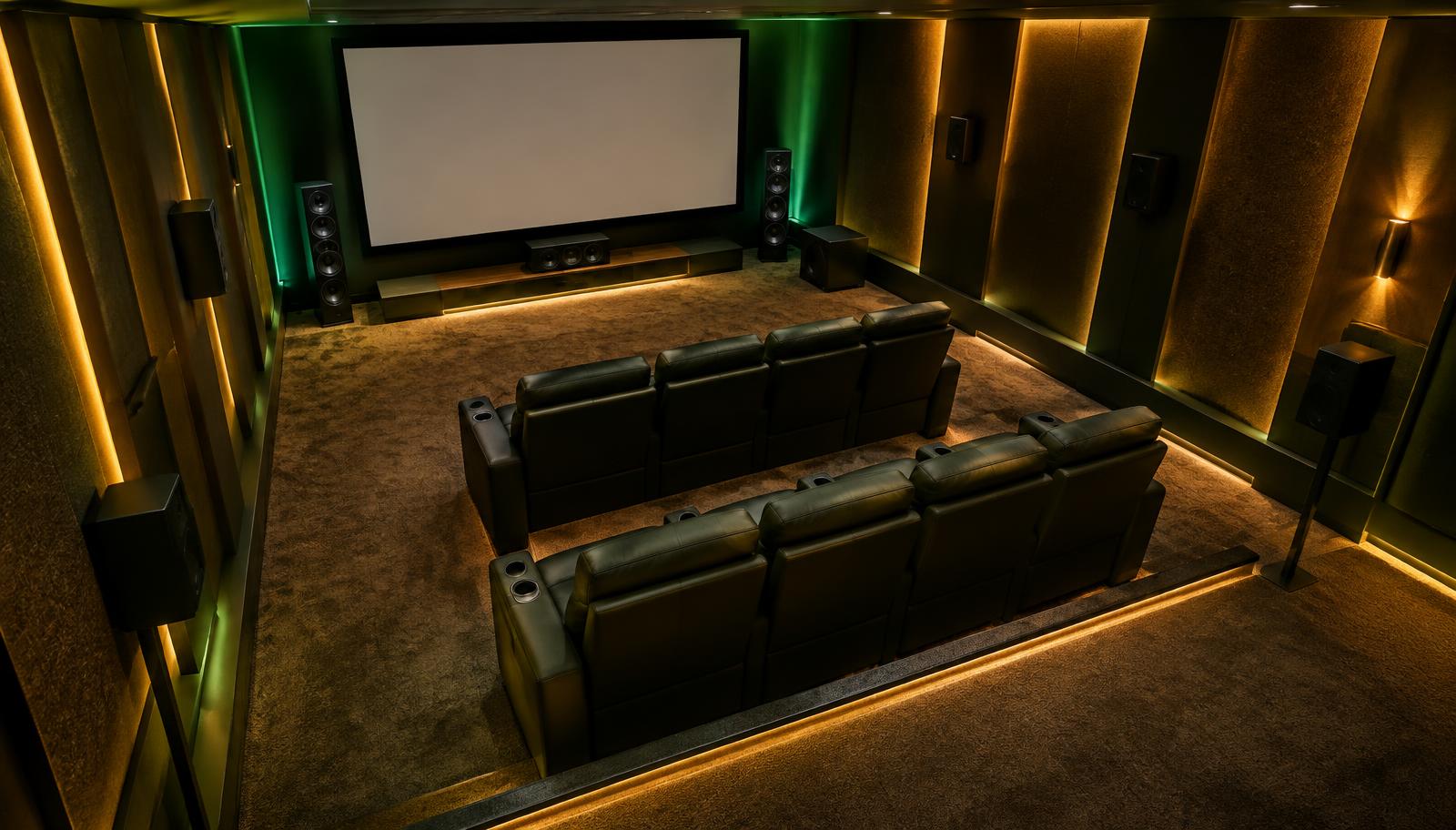
Begin with the main listening position and use the current Dolby layout drawing for the chosen configuration. Keep the front stage connected to the picture, place surrounds around the listening area, reserve rear channels for rooms with usable space behind the seats, and create audible vertical separation between the bed and height layers. For layout-by-layout planning, use the speaker placement guide.
5.1.2 normally uses one left/right height pair
5.1.4 adds a second pair to create front-to-back overhead movement
7.1.2 adds rear surrounds to the ear-level layer
7.1.4 combines side and rear surrounds with two height pairs
Multiple rows require coverage and compromise checks, not one-seat assumptions
The AV Receiver Must Support the Whole Layout at Once
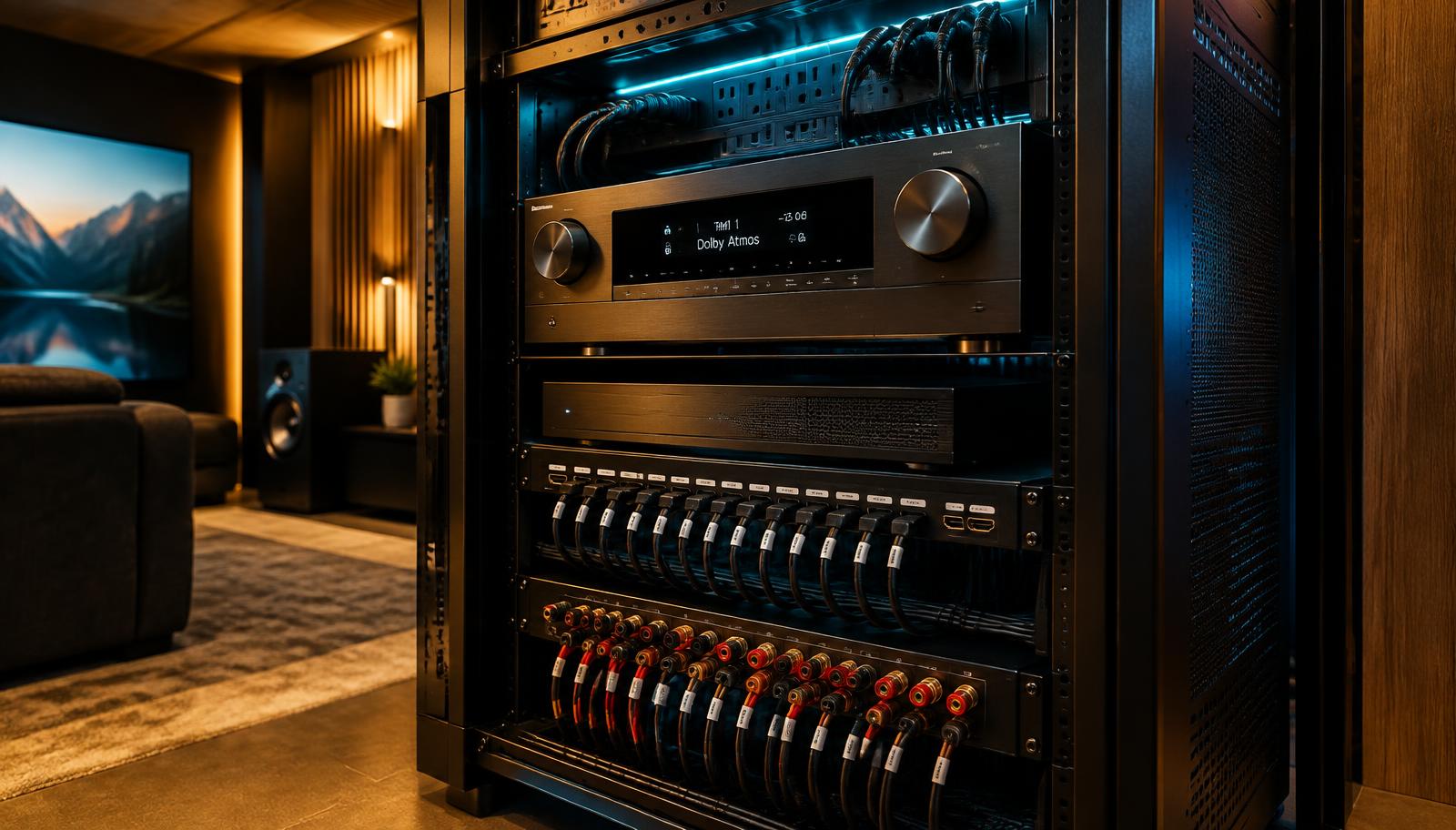
Atmos decoding is only one requirement. Confirm the receiver’s current official specification for simultaneous processing channels, built-in amplified channels, assignable outputs, external-amplifier options, HDMI inputs and outputs, eARC, required video formats, bass management and room correction. Amplified channels, processed channels and connected physical speakers are not interchangeable terms. Use the AV receiver buying guide to build a requirement profile before comparing models.
Source, Content and Playback Device Must Stay Compatible
An Atmos label on one component does not make the entire chain Atmos-capable. Verify the title or game, subscription tier or disc, application, playback device, connection method and receiver input. Streaming catalogues and device support change, so check the current provider and device documentation rather than assuming every title carries an Atmos mix.
Acoustics Affect Height Clarity and Bass
Long reverberation and strong early reflections can blur directional transitions. Ceiling construction also affects direct or reflected height methods. Acoustic treatment manages sound inside the room; sound isolation reduces transmission through the building. Neither should be confused with decorative foam. Continue with the room acoustics guide.
Calibration Integrates the Layers
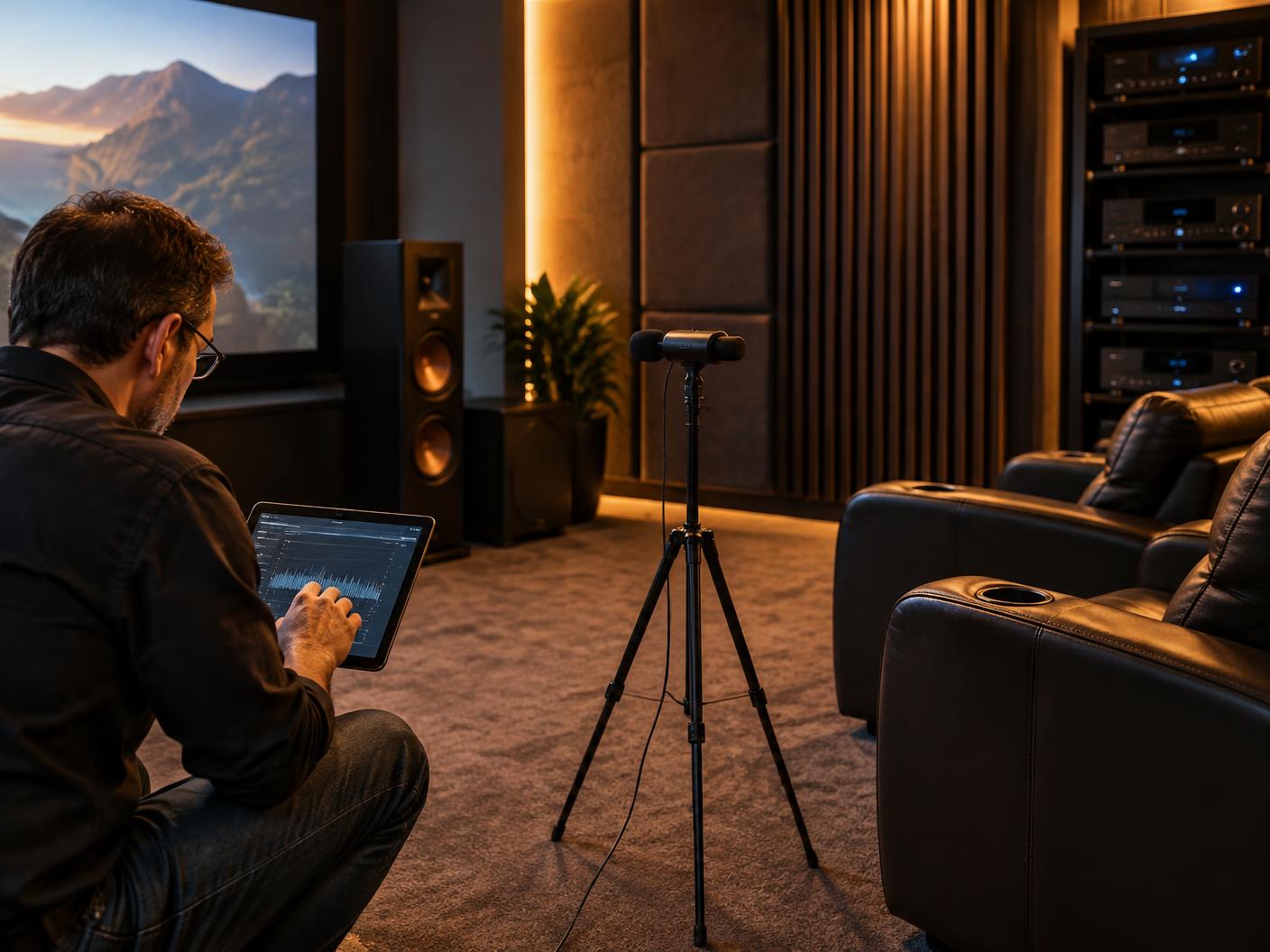
Commissioning should verify polarity, channel assignment, distance, level, crossover, subwoofer phase and delay, then evaluate more than one seat when the system serves a family. Automated room correction is useful, but it cannot repair missing geometric separation, a blocked speaker or a seat in a severe cancellation.
Dolby Atmos Pre-Wiring Checklist
For a new build or renovation, document every speaker and service path before ceilings close.
Left, centre and right front stage
Side surrounds and optional rear surrounds
Top-front and top-rear height pairs
One or more practical subwoofer locations
HDMI and network paths between sources, rack and display
Power, ventilation and service access
Labelled conduit and draw wires for later changes
What Changes Dolby Atmos Project Cost
A responsible estimate follows a room survey. Cost changes with configuration, speaker construction, receiver and amplification needs, subwoofer plan, ceiling access, wire routes, acoustic treatment, isolation, equipment ventilation, control integration, calibration and construction stage. These drivers are more useful than a universal package figure.
A Practical Atmos Design Sequence
Fix the room brief and seating first; compare layouts second; confirm ceiling method and speaker positions third; specify processing and amplification fourth; coordinate wiring, rack, network and power fifth; then install, verify, calibrate and document. This sequence avoids buying a receiver before the final channel count or closing a ceiling before height positions are resolved.
Dolby Atmos Planning in Hyderabad and Vijayawada
Finished apartments often require discreet routing and neighbour-aware bass, while villas and dedicated rooms benefit from early ceiling, conduit, rack and acoustic coordination. LiveInSmart supports room-led planning through the Hyderabad Experience Centre, Vijayawada Experience Centre and the existing contact flow.
Why LiveInSmart
LiveInSmart treats Atmos as a system-integration problem: room, seating, speaker geometry, electronics, acoustics, control and documentation are designed together. After installation, support can include operating guidance, source changes, configuration checks, re-calibration after room changes and troubleshooting based on the recorded system design.
Experience Centre · Hyderabad
Visit our Hyderabad showroom
Book a free demo at the LiveInSmart Hyderabad Experience Centre — listen to Dolby Atmos, see 4K laser projectors and walk through live home-automation scenes before you buy.
Pancom Business Centre, Mumbai Hwy, Nagarjuna Nagar Colony, Ameerpet, Hyderabad 500073
It is an immersive audio format that adds height information to a compatible surround system, allowing supported sound objects to be reproduced above and around listeners.
What does 5.1.2 mean?+
Five ear-level channels, one low-frequency-effects channel and two height channels. More than one physical subwoofer can reproduce the managed bass channel.
What does 5.1.4 mean?+
Five ear-level channels, one LFE channel and four height channels, commonly arranged as front and rear height pairs around the listening area.
Is 7.1.4 better for every room?+
No. It needs useful space for side and rear surrounds plus four suitable height positions. A correctly placed 5.1.4 can be more coherent in a smaller room.
Do I need ceiling speakers for Dolby Atmos?+
Not in every implementation. Direct ceiling speakers, Atmos-enabled up-firing modules and some soundbars can reproduce height information, but their room requirements and results differ.
Are up-firing speakers suitable for Atmos?+
They can be suitable when the ceiling reflection path meets the speaker and Dolby guidance. Ceiling shape, height, material and obstructions should be checked first.
How many Atmos speakers do I need?+
Two height channels create an entry height layer; four can provide stronger front-to-back movement. The suitable count depends on room geometry, seating and receiver capability.
Do I need a special AV receiver?+
You need a receiver or processor that supports the format and can process and amplify the intended layout simultaneously. Verify the current official model specification.
Does every movie or stream support Dolby Atmos?+
No. Support varies by title, application, device, connection and service tier, and can change over time.
Can Dolby Atmos work in a living room?+
Yes, when the room can support suitable speaker geometry and the chosen height method. Multipurpose-room constraints should guide the layout.
Can I upgrade an existing 5.1 system to Atmos?+
Often, if the receiver, wiring, ceiling and speaker plan support additional height channels. Confirm capability before purchasing speakers.
How much does Dolby Atmos installation cost?+
It depends on layout, electronics, speaker and subwoofer choices, ceiling access, wiring, acoustics, construction and calibration. A room assessment is required for a meaningful scope.
Does room correction replace acoustic treatment?+
No. Correction can improve response within limits, while treatment manages physical reflections and decay. Neither repairs poor speaker geometry.
Design a room-specific Atmos layout?
Share the room, seats, ceiling type and planned sources. LiveInSmart will help map a practical configuration and installation path.