Soundproofing Solutions for Homes, Theatres and Offices
Road traffic in the bedroom, the neighbour's TV through a shared wall, your home theatre keeping the family awake — these are isolation problems, and panels will not fix them. We build soundproof walls, ceilings and floors and fit acoustic doors and sound-reducing windows, treating the room as one system so noise has no easy way through.
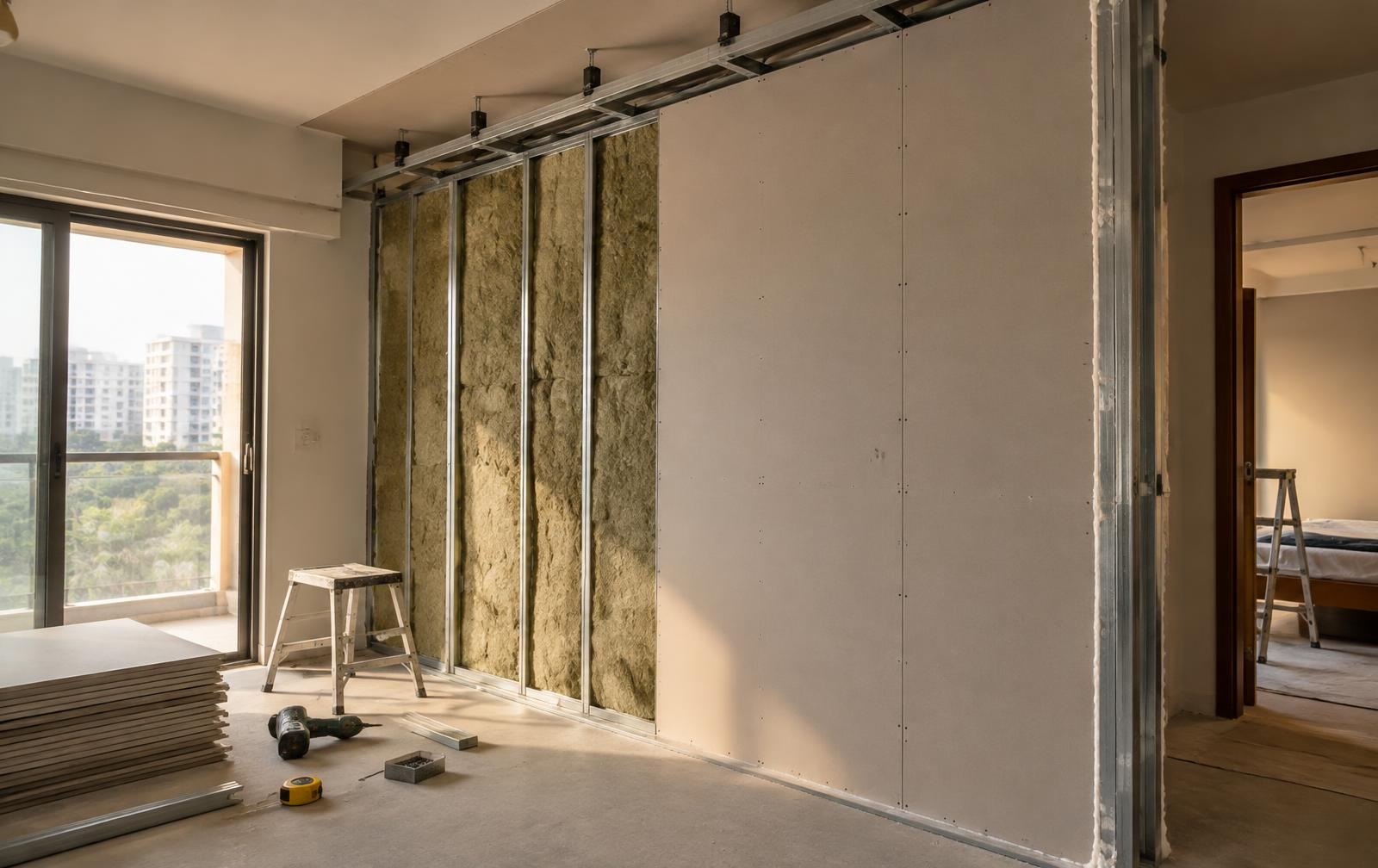
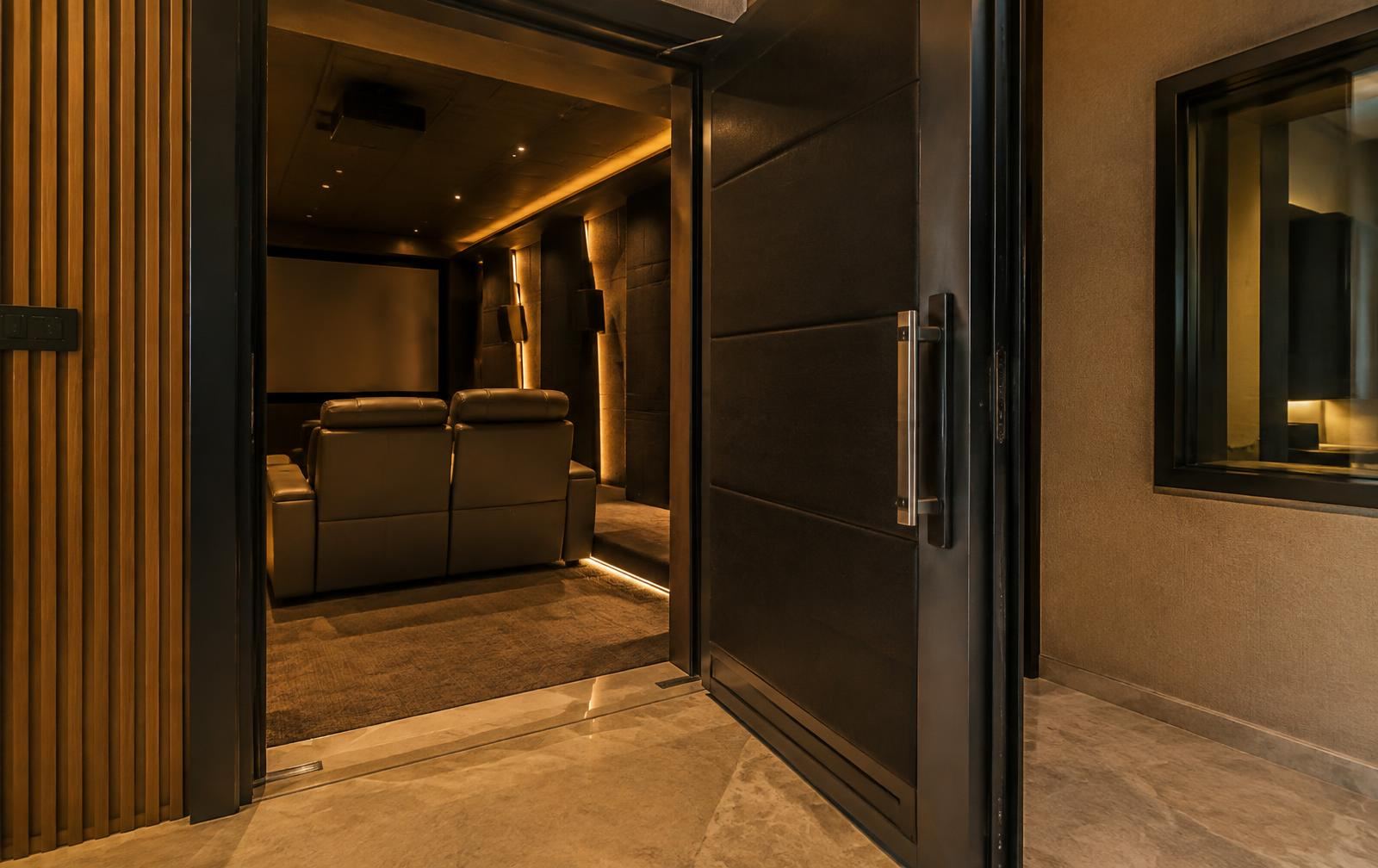
Illustrative images of typical build-ups. Ask us for photos of completed work similar to your project.
Quick answer
Soundproofing (sound isolation) stops sound travelling between spaces. It works through added mass, decoupling (separating layers so vibration cannot pass straight through), insulation in the cavities and sealing every gap — usually across walls, ceiling, floor, door and windows together, because sound escapes through the weakest point. Acoustic panels alone cannot soundproof a room.
Noise Problems We Solve
Tell us where the noise comes from and where you hear it — that decides which surfaces need work.
Traffic, horns and construction noise coming through windows and walls
Neighbours' voices, TV or music through shared apartment walls
Home theatre or music room sound reaching bedrooms and neighbours
Recording studio, podcast or rehearsal room sound leaking in or out
Conversations overheard between office cabins and meeting rooms
Footsteps and impact noise from the floor above
Generator, pump or AC plant noise
How Soundproofing Works
Every effective soundproofing build uses the same four principles. Skipping one usually undoes the others.
The four principles of sound isolation
Principle
What it means
Example
Mass
Heavier, denser layers block more airborne sound
Additional board layers on a wall or ceiling
Decoupling
Break the solid path vibration travels along
An independent stud wall; a ceiling on isolation hangers
Cavity insulation
Absorbs sound inside the wall or ceiling cavity
Mineral wool between studs
Sealing
Close every air gap — sound leaks wherever air can
Acoustic sealant at edges; perimeter and drop seals on doors
What We Build
We work on the surfaces that matter for your noise path — often more than one.
Wall soundproofing
An additional isolated wall or lining in front of the existing wall, with insulation in the cavity and sealed edges — for shared apartment walls, bedrooms next to a home theatre and office cabins.
Ceiling soundproofing
A ceiling hung on isolation hangers below the slab with insulation above, for noise from the flat upstairs and for home theatres under bedrooms.
Floor soundproofing
Floating or isolated floor build-ups that reduce impact and footfall noise travelling to the room below.
Acoustic doors
Heavy, sealed doors with perimeter seals and drop seals. A normal hollow door is usually the weakest point of any room.
Sound-reducing windows
Windows designed to reduce outside noise, sealed properly into the opening — the main fix for traffic noise.
Home theatres, studios and offices
Complete rooms where walls, ceiling, floor, door, windows and AC openings are planned together.
The Weakest-Link Rule
Sound is like water — it finds the smallest gap. A beautifully built wall loses much of its benefit if the door is hollow or the AC duct is open.
Doors and door gaps
Windows and their frames
AC ducts, pipes and refrigerant line openings
Electrical boxes on both sides of the same wall
Gaps where the wall meets the ceiling or floor
Plan It Before the Interiors
Soundproofing is construction. It is easiest and most effective before the false ceiling, flooring, wardrobes and paint go in. Isolated walls and ceilings also take up a few inches of room depth, which your interior designer needs to know early. Existing rooms can still be improved — doors, windows and sealing are often the first step.
What We Will Not Promise
We do not quote a fixed decibel or STC figure for your room. Results depend on your building's existing construction and every gap around the room. We explain what each option can realistically achieve, including the limits — very low bass is the hardest sound to stop.
Soundproofing vs Acoustic Treatment
Once noise is kept in or out, the room itself may still echo. That is fixed with acoustic treatment, usually after the soundproofing work.
Soundproofing is construction work, so it is planned with your interior designer or contractor before false ceilings, flooring and paint.
Tell us about the problem — WhatsApp photos, a floor plan or a short video of the room help
Site visit to find where noise enters or escapes — walls, ceiling, floor, door, windows, AC and electrical openings
Written recommendation and quotation listing each surface, the treatment or build-up proposed and the finish
Installation by our team, coordinated with your interior designer, carpenter or civil contractor
Handover walkthrough, then after-sales support — we respond to service requests within 48 hours
Soundproofing in Hyderabad and Vijayawada
Our Hyderabad team works from the Ameerpet experience centre and covers Jubilee Hills, Banjara Hills, Gachibowli, Kondapur, Kokapet, Madhapur, Manikonda, Kukatpally and Secunderabad and the rest of Telangana. Our Vijayawada team works from Kanuru and covers Benz Circle, Kanuru, Patamata, Gunadala, Poranki, Amaravati, Mangalagiri, Tadepalli and Guntur and coastal Andhra Pradesh. Visit either centre with your floor plan or room photos to talk the project through.
Soundproofing Across Telangana and Andhra Pradesh
Hyderabad and Vijayawada are our two bases. The Hyderabad team covers Telangana and western Andhra Pradesh; the Vijayawada team covers coastal and southern Andhra Pradesh. For cities without a showroom we start with a remote review of drawings, photos and requirements, then schedule site visits for survey, installation, training and after-sales service as the project needs.
Soundproofing coverage by city
City
State
Served from
Coverage
Hyderabad
Telangana
Hyderabad team
Showroom, demo room and local team
Vijayawada
Andhra Pradesh
Vijayawada team
Showroom, demo room and local team
Guntur
Andhra Pradesh
Vijayawada team
Regular site visits from the Vijayawada team
Eluru
Andhra Pradesh
Vijayawada team
Regular site visits from the Vijayawada team
Warangal
Telangana
Hyderabad team
Remote drawing review first; site visits scheduled per project
Karimnagar
Telangana
Hyderabad team
Remote drawing review first; site visits scheduled per project
Nizamabad
Telangana
Hyderabad team
Remote drawing review first; site visits scheduled per project
Khammam
Telangana
Hyderabad team
Remote drawing review first; site visits scheduled per project
Mahabubnagar
Telangana
Hyderabad team
Remote drawing review first; site visits scheduled per project
Siddipet
Telangana
Hyderabad team
Remote drawing review first; site visits scheduled per project
Visakhapatnam
Andhra Pradesh
Vijayawada team
Remote drawing review first; site visits scheduled per project
Rajahmundry
Andhra Pradesh
Vijayawada team
Remote drawing review first; site visits scheduled per project
Kakinada
Andhra Pradesh
Vijayawada team
Remote drawing review first; site visits scheduled per project
Vizianagaram
Andhra Pradesh
Vijayawada team
Remote drawing review first; site visits scheduled per project
Ongole
Andhra Pradesh
Vijayawada team
Remote drawing review first; site visits scheduled per project
Nellore
Andhra Pradesh
Vijayawada team
Remote drawing review first; site visits scheduled per project
Tirupati
Andhra Pradesh
Vijayawada team
Remote drawing review first; site visits scheduled per project
Kurnool
Andhra Pradesh
Hyderabad team
Remote drawing review first; site visits scheduled per project
Nandyal
Andhra Pradesh
Hyderabad team
Remote drawing review first; site visits scheduled per project
Kadapa
Andhra Pradesh
Vijayawada team
Remote drawing review first; site visits scheduled per project
Anantapur
Andhra Pradesh
Hyderabad team
Remote drawing review first; site visits scheduled per project
Bring your floor plan, room photos or interior drawings to our Hyderabad (Ameerpet) or Vijayawada (Kanuru) experience centre and talk the project through with our team.
Pancom Business Centre, Mumbai Hwy, Nagarjuna Nagar Colony, Ameerpet, Hyderabad 500073
Start with the openings: a sealed acoustic door and sound-reducing windows usually make the biggest difference for traffic noise. Then seal gaps around frames, AC lines and electrical boxes. If noise still comes through the walls or ceiling, add an isolated wall or ceiling layer with insulation in the cavity.
Can acoustic panels or foam soundproof a room?+
No. Panels and foam absorb sound inside a room but let most of it pass through the wall. Soundproofing needs mass, decoupled layers, cavity insulation and sealed gaps.
Can my existing room be soundproofed without breaking walls?+
Partly. Replacing the door, upgrading windows and sealing gaps can make a clear difference without civil work. Isolating walls and ceilings needs new layers built inside the room.
How much space does a soundproof wall take?+
An isolated wall or ceiling adds a few inches of depth. The exact thickness depends on the build-up chosen; we tell you before work starts so your interior plan can allow for it.
Will soundproofing stop all noise?+
It reduces noise substantially when the whole room is treated as a system, but no practical room is completely silent. Very low bass and impact noise are the hardest to stop.
Is an acoustic door really necessary?+
Usually, yes. A normal door has gaps around it and a light core, so it lets through far more sound than the wall around it.
Can you guarantee a fixed decibel reduction?+
No, and be careful of anyone who does without testing your exact construction. How much noise is stopped depends on the existing walls, slab, doors, windows and how carefully every gap is sealed. We explain the options and their trade-offs honestly before work starts.
Is the consultation free?+
Yes, the consultation is free. For sites far from Hyderabad and Vijayawada, a site visit may carry a visiting charge based on distance — we always tell you the amount before we travel.
Ready to upgrade your space?
Book a free, no-obligation demo at our Hyderabad or Vijayawada experience centre and hear it for yourself.