Home Theatre Setup in Financial District, Hyderabad
Financial District residences are predominantly high-rise, well-finished and time-poor households — so the brief here is a premium system that installs cleanly, works on one button and does not require the family to become AV enthusiasts.
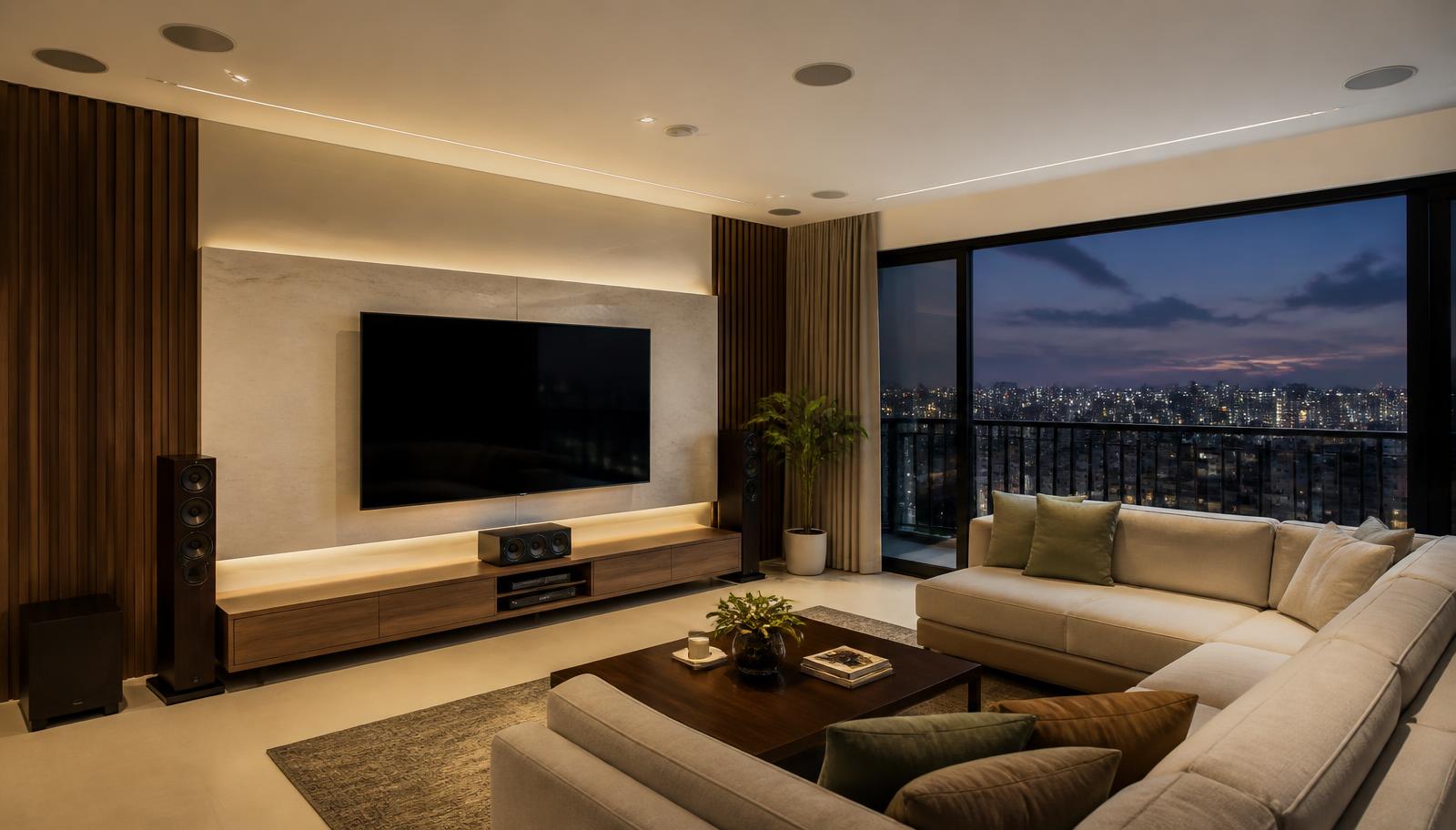
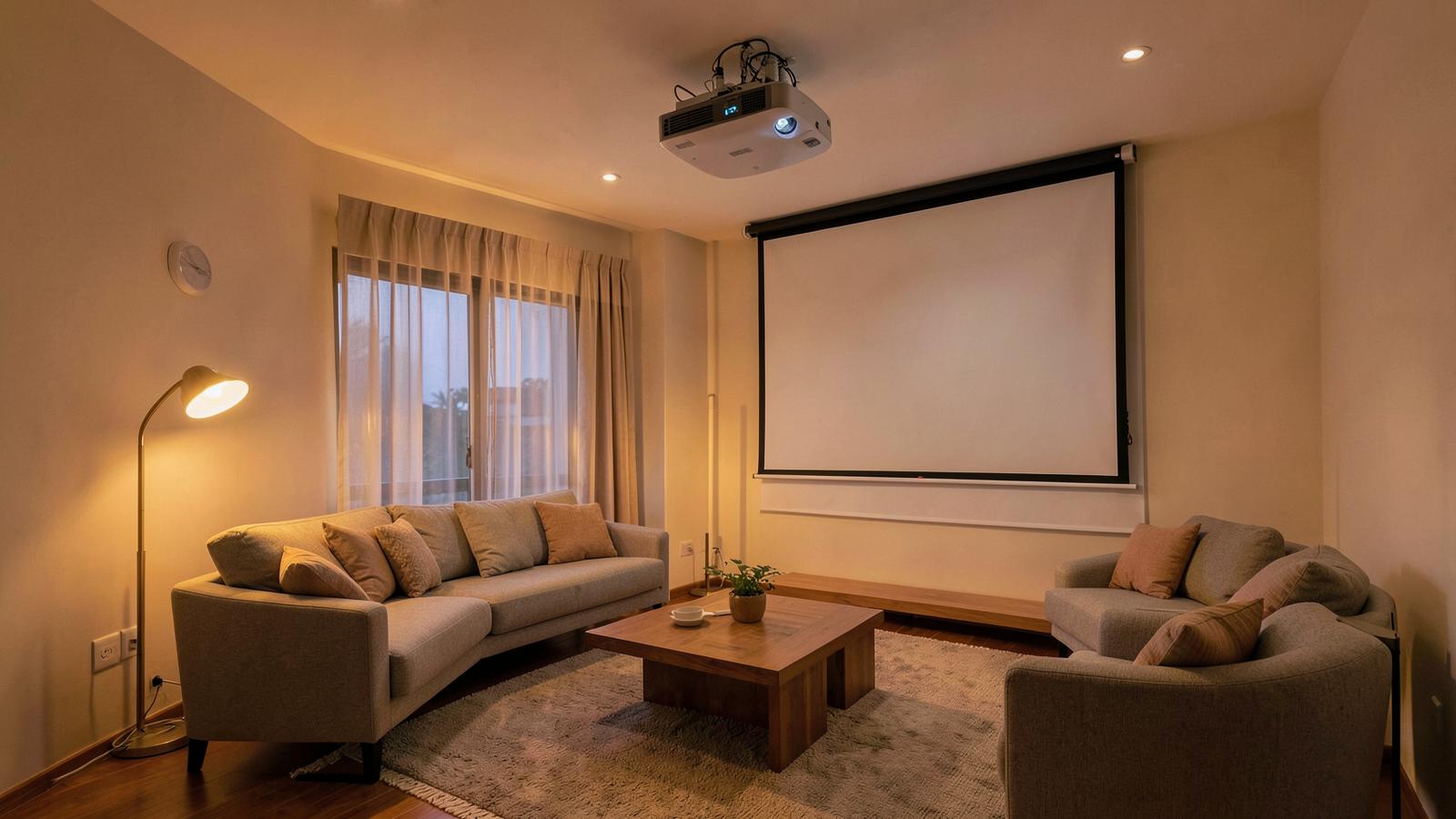
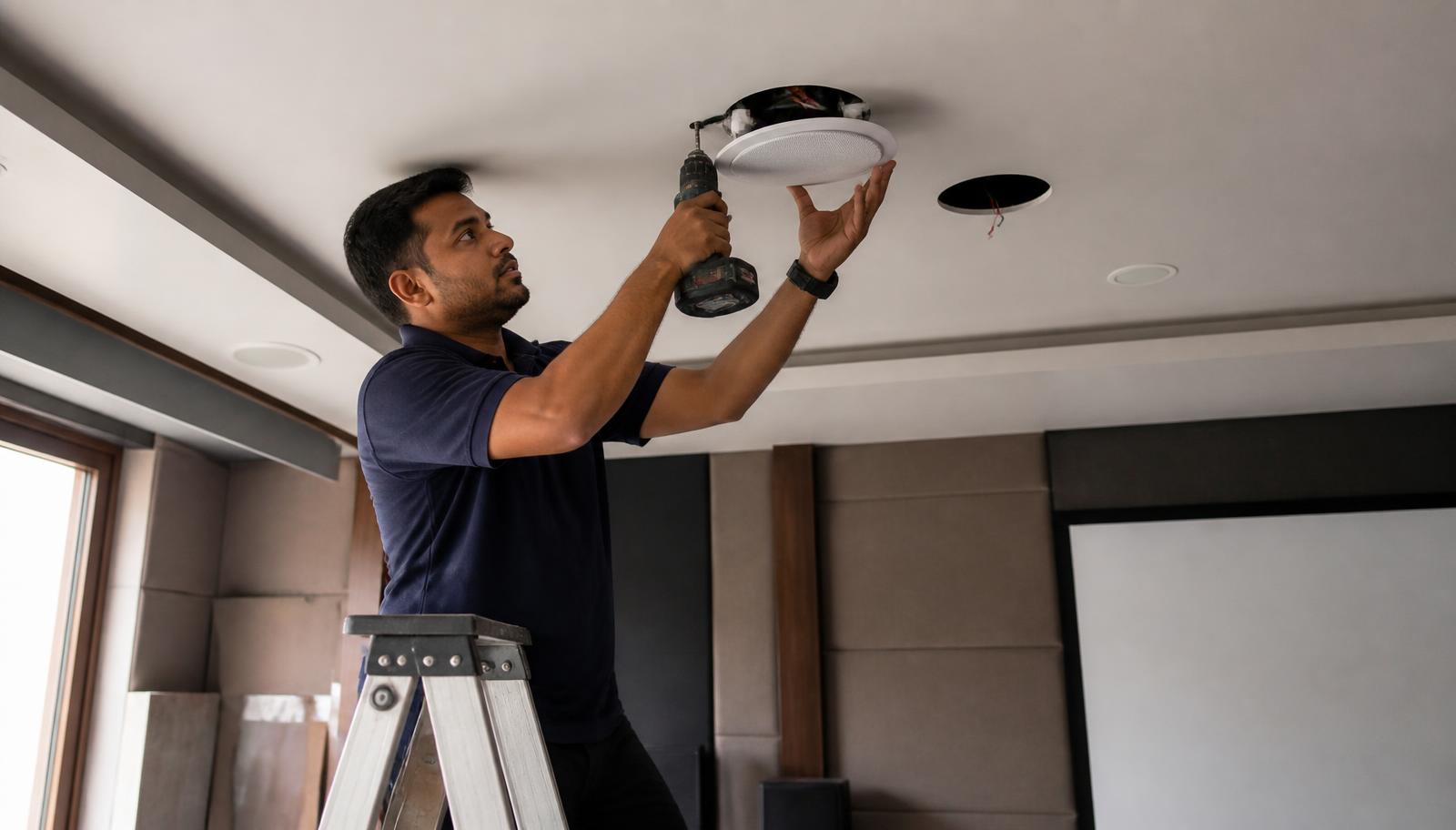
Concealed system in a high-rise living roomProjector with automated shade controlIn-ceiling height channels
Quick answer
For a Financial District high-rise, we typically design a concealed 5.1.2 Dolby Atmos system: in-wall front speakers, in-ceiling height channels, a sealed subwoofer set to be neighbour-safe, a large display or a motorised screen with a compact laser projector, motorised shades to control the glass, and single-command scenes for movie, music and gaming. Cabling is planned through the existing false ceiling with the minimum practical cutting.
What type of home theatre works best in Financial District?
Financial District is dominated by living-room cinema and premium smart cinema. Dedicated rooms are unusual in these floor plans, and we will recommend a well-executed living-room system rather than force a room that does not exist.
There are three formats worth considering, and the right one is decided by your room and how the family uses it — not by budget alone.
Living room cinema
The system shares the room with everyday life. Concealed speakers, a display or a motorised screen and a subwoofer that behaves at family volume. Best for households that want cinema sound every day rather than a special-occasion room.
Dedicated home theatre
A separate room designed around the seating: controlled light, acoustic treatment, fixed speaker positions and projection. Delivers the best sound and picture, but it is a room you go to rather than a room you live in.
Premium smart cinema
Either of the above with lighting, curtains, climate and AV under one control layer, so the room changes state on a single command. Best where automation is already planned or installed.
Designing for a glass-heavy high-rise living room
Floor-to-ceiling glazing is the defining feature of most residences here. It looks superb and it is acoustically and visually hostile to a cinema — reflective, bright, and difficult to treat conventionally.
Shades or heavy drapes do double duty: light control and reflection control
Rugs and soft furnishing matter more here than in a conventional room
Screen or TV position should avoid facing the glass directly where possible
Rear surround mounting often needs brackets rather than stands in open plans
Confirm society rules for drilling, working hours and material movement early
Smart home theatre solutions for Financial District residences
High-rise living puts three constraints on a home theatre: limited wall depth, a lot of glass, and neighbours on every side. A good design answers all three at once — concealed hardware that respects the interior, shade and lighting control that makes the screen watchable, and low-frequency management that keeps the system inside your own flat.
In-wall and in-ceiling hardware to preserve floor area and sightlines
Motorised shades or blackout curtains integrated into the movie scene
Sealed subwoofer, isolated and calibrated for a shared-slab building
Single-app or keypad control instead of multiple remotes
Installation scheduled around society drilling hours and lift access
Which home theatre configuration should you choose?
Channel count should follow the room. More speakers do not automatically mean better sound — badly placed extra channels can make a small room worse.
Home theatre configurations compared
Configuration
Speakers
Atmos
Best suited for
5.1
5 + subwoofer
No
Apartment living rooms; the reliable baseline
5.1.2
5 + sub + 2 height
Yes
Apartment or compact hall wanting Atmos
7.1
7 + subwoofer
No
Longer rooms with space behind the seating
7.1.2
7 + sub + 2 height
Yes
Large hall where only two ceiling positions work
7.1.4
7 + sub + 4 height
Yes
Villa hall or dedicated room; the reference sweet spot
9.2.6
9 + 2 subs + 6 height
Yes
Dedicated cinema with separate amplification
Projector or large TV for your Financial District home?
A large display is the default for these apartments because of the daylight. Add a projector and motorised screen only when shade control is part of the project — with automated blackout, a projector transforms evening viewing without giving up the daytime television.
The honest comparison: a TV wins on brightness, everyday convenience, gaming latency and zero maintenance. A projector wins on image size per rupee and on the cinema feel, but it needs light control, a suitable throw distance and occasional filter or lens care. Neither is universally better — the room decides.
Dolby Atmos home theatre in Financial District
Dolby Atmos adds height channels so sound can be placed above you. The number after the second dot is the height-channel count: 5.1.2 has two, 5.1.4 and 7.1.4 have four, and 9.2.6 has six.
5.1.2 covers most Financial District living rooms. 5.1.4 is achievable in the larger four-bedroom layouts where the ceiling can take four cut-outs at sensible angles.
In-ceiling speakers give the most convincing overhead effect because the sound genuinely comes from above; up-firing modules bounce sound off a flat ceiling and are the practical choice where the ceiling cannot be cut. Either way, the AV receiver or processor must support Atmos and have enough amplifier channels, and the layout must be calibrated. Full detail on layouts and placement is on our Dolby Atmos home theatre in Hyderabad page.
Do you need acoustic treatment?
Rooms colour sound. Hard floors, bare walls and large glass create reflections that blur dialogue and smear the surround image, and corners build up bass unevenly. Treatment addresses that; it is not the same as soundproofing, which is isolation work designed to stop sound leaving the room.
Absorption at the first reflection points on the side walls and ceiling
Bass trapping in the corners, where low-frequency energy collects
Diffusion at the rear of a dedicated room to keep it lively rather than dead
Rugs over hard flooring and curtains over large glass — the cheapest real gains
Treatment improves what you hear inside the room; it does not stop sound leaving it
Turn your home theatre into a smart cinema
This is where an AV integrator differs from an equipment seller. Because we also design home automation, your theatre can run as a set of scenes rather than five remotes. The exact integrations depend on the equipment and control platform selected, and we confirm the achievable list before you buy.
Movie — projector on, screen down, receiver on the right input, lights dimmed, curtains closed
Pause — lights rise to a low level automatically when playback pauses
Gaming — display switched to game mode input, brighter light preset, surround profile changed
Music — display off or dimmed, stereo or multi-channel music preset, softer lighting
Exit — everything powers down in the right order and the lights return to normal
Building or renovating your home in Financial District?
New handovers are common here. Ask us before the false ceiling closes — the difference in cost and finish between planned and retro-fitted cabling in a high-rise is substantial.
AV planning should happen before the false ceiling, electrical first fix, flooring, carpentry and wall finishing — because every one of those closes off a cable route.
Speaker cable to every surround, rear and ceiling position
HDMI and network cable to the display or projector location, with a spare pull cord
Power at the projector mount and at two candidate subwoofer positions
Screen drop pocket coordinated with the false-ceiling design
Control cable to the lighting panel and curtain motors
How much does a home theatre setup cost in Financial District?
Costs here typically land in the mid to premium range, driven by concealment, shade automation and control programming rather than by speaker count. A well-calibrated 5.1.2 in a treated, shaded room outperforms a larger uncalibrated system in the same flat.
Actual pricing depends on room size, equipment, acoustics, civil work, installation requirements and automation. The ranges below are indicative and are confirmed only after a site visit.
Indicative ranges — confirmed only after a site visit
Budget
Typical configuration
Usually includes
₹1.5L – ₹3L
5.1 living room
AV receiver, five speakers, subwoofer, mounting, calibration
₹3L – ₹5L
5.1.2 Atmos
Adds two height channels and better front speakers
₹5L – ₹10L
5.1.4 or entry projection
Four heights, projector and screen, or a step up in speaker tier
A complete home cinema is the sum of: display or projector, screen, AV receiver or processor, speakers, subwoofer, acoustic treatment, cabling and installation, automation and seating. Treatment, automation and seating are optional in a living-room system and close to essential in a dedicated room. The display and the speakers usually dominate the budget in an apartment; the room build usually dominates it in a dedicated cinema.
How LiveInSmart installs a home theatre
Every project follows the same sequence so you always know what happens next.
System design — layout, speaker angles, screen size and display distance
Equipment selection — matched to the room and your budget, with alternatives shown
Wiring and infrastructure — conduit, speaker runs, HDMI, power and control cable
Installation — mounting, rack build, concealed cabling and terminations
Acoustic treatment — where the room and scope call for it
Calibration — measurement microphone, distances, levels, crossovers and room EQ
Automation integration — scenes for lighting, curtains, screen and projector
Testing and handover — walkthrough, documented settings and after-sales support
Home theatre installation in Financial District and nearby Hyderabad areas
LiveInSmart serves high-rise residences in the Financial District and adjoining areas such as Nanakramguda, Kokapet, Gachibowli and Manikonda, subject to building access, society approvals and project requirements.
Our experience centre is in Ameerpet; we do not operate a branch inside Financial District. Site visits, design, installation and service are delivered to your home from there.
Why choose LiveInSmart for your home theatre
We sell a designed outcome rather than a box list: room-specific design, complete AV integration, acoustic planning, projector and display selection, Dolby Atmos layout, installation, measured calibration, smart-home integration, an upgrade path and after-sales support — from one accountable team.
Experience your home theatre before you buy
Audition multiple Dolby Atmos configurations and speaker tiers side by side, on the same content, at the LiveInSmart Hyderabad experience centre: Pancom Business Centre, Mumbai Hwy, Nagarjuna Nagar Colony, Ameerpet, Hyderabad 500073. Appointments are preferred for private auditions — book a demo or see our Hyderabad location page.
Book a free demo at the LiveInSmart Hyderabad Experience Centre — listen to Dolby Atmos, see 4K laser projectors and walk through live home-automation scenes before you buy.
Pancom Business Centre, Mumbai Hwy, Nagarjuna Nagar Colony, Ameerpet, Hyderabad 500073
Can a high-rise apartment support a proper home theatre?+
Yes. The constraints are wall depth, glass and shared structure, and all three have design answers: in-wall and in-ceiling hardware, shade and soft-furnishing control, and a sealed, calibrated subwoofer. A concealed 5.1.2 Atmos system in a well-shaded living room is a genuinely cinematic experience.
How do you deal with floor-to-ceiling glass?+
With shading and soft furnishing. Motorised blackout shades or heavy drapes cut reflection and ambient light in one move, and a rug plus fabric seating absorbs the early reflections that make dialogue hard to follow. Treating the glass is usually more effective than adding equipment.
Will my apartment association allow the installation?+
Typically yes, subject to permitted working hours, drilling restrictions and lift or service-entry rules. We plan the schedule around those constraints; you or your facility manager will need to obtain any written approval the association requires.
Can everything run from a single button?+
That is usually the objective here. One scene can dim the lights, close the shades, power the display or projector, switch the AV receiver input and start playback. What is achievable depends on the control capability of the equipment selected, which we confirm during design.
How much wall space do the speakers need?+
In-wall speakers need enough stud or dry-wall depth, which we verify on site; where the wall is solid, slim on-wall or bookshelf speakers are used instead. Height channels go into the false ceiling, so they take no wall space at all.
Is a soundbar enough for a premium apartment?+
A good soundbar is a real improvement over TV speakers and suits some households. It cannot reproduce the surround envelopment or the low-frequency weight of discrete speakers and a subwoofer. If you want genuine cinema, a 5.1 or 5.1.2 system is the step up worth making.
How disruptive is the installation?+
For a concealed system in a finished flat, there is cutting for ceiling speakers and cable routes, followed by patching and touch-up. We show you every proposed cut before starting and work within the society's permitted hours, so the disruption is planned rather than discovered.
Ready to upgrade your space?
Book a free, no-obligation demo at our Hyderabad or Vijayawada experience centre and hear it for yourself.